
Uneven tone, redness, clogged pores, and post-breakout marks can be stubborn because several skin processes may be involved at once. A useful treatment needs to address those concerns without creating unnecessary irritation.
Paula’s Choice 10% Azelaic Acid Booster combines 10% azelaic acid with 0.5% salicylic acid, soothing ingredients, and a lightweight gel-cream base. The current formula is documented on the company’s official product page.
What stands out to me is the difference between promising ingredients and proven product performance. The formula has credible science behind some of its actives, but the available research does not establish that this exact finished product produces every advertised result.
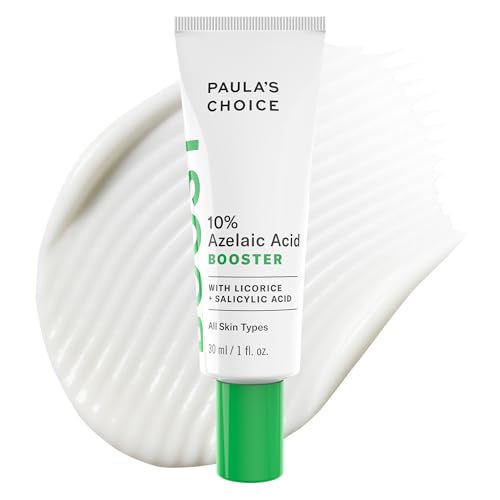
Paula’s Choice 10% Azelaic Acid Booster Review: Quick Summary
Product type: Leave-on skincare booster
Main purpose: Uneven tone, redness, blemishes, and discoloration
Best for: Breakout-prone and uneven-looking skin
May not suit: Very reactive skin or active irritation
Key ingredients or features: 10% azelaic acid, 0.5% salicylic acid, adenosine, soothing extracts
Return policy or guarantee: 100% money-back guarantee; duration not clearly displayed on the current U.S. product page
Overall rating: 4.1/5
What Is Paula’s Choice 10% Azelaic Acid Booster?
This is a leave-on facial treatment formulated as a lightweight, oil-free gel-cream. Paula’s Choice positions it for breakouts, brown spots, redness, dullness, and uneven-looking skin, according to its current product details.
The formula contains 10% azelaic acid plus 0.5% salicylic acid. It can be used alone, targeted at blemished areas, or mixed with a serum or non-SPF moisturizer. The brand gives these directions in its usage guidance.
From a consumer perspective, its main distinction is combination treatment. You get an ingredient with evidence for acne and pigmentation alongside a pore-exfoliating BHA and several calming ingredients, rather than relying on azelaic acid alone.
What Does Paula’s Choice 10% Azelaic Acid Booster Claim to Do?
Paula’s Choice mainly presents the booster as a multitasking treatment. Its current product description says it can:
- Fade the appearance of brown spots
- Reduce the look of redness
- Fight breakouts
- Smooth uneven texture
- Improve the appearance of dull skin
- Support a more even-looking complexion
Some of these claims are reasonably specific, while others are cosmetic phrases that are difficult to measure consistently. I find the acne and discoloration claims easier to connect with established azelaic-acid research.
The weaker part is product-specific proof. The company highlights ingredient research, but that doesn’t mean researchers have clinically tested this exact formula against a control.
How Is Paula’s Choice 10% Azelaic Acid Booster Supposed to Work?
Azelaic acid has several plausible actions. It can reduce inflammation, influence abnormal follicular cell growth, and interfere with processes involved in pigmentation. These mechanisms help explain its established dermatologic uses, as summarized by DermNet’s azelaic-acid review.
Salicylic acid adds a different approach. It is oil-soluble and exfoliates inside pores, while the formula’s soothing ingredients are intended to make the treatment more comfortable. The mechanism is biologically plausible, but plausibility isn’t the same as proof.
Paula’s Choice 10% Azelaic Acid Booster Ingredients at a Glance
The current U.S. product page lists the following formula. Paula’s Choice also warns that ingredient lists can change, so packaging remains the final reference. The complete current ingredient list is available on the manufacturer’s site.
Main ingredients:
- Azelaic acid: 10%
- Salicylic acid: 0.5%
- Adenosine: Amount not disclosed
- Licorice root extract: Amount not disclosed
- Allantoin: Amount not disclosed
Complete ingredient list:
- Water
- Azelaic Acid
- C12-15 Alkyl Benzoate
- Caprylic/Capric Triglyceride
- Methyl Glucose Sesquistearate
- Glycerin
- Cetearyl Alcohol
- Glyceryl Stearate
- Dimethicone
- Salicylic Acid
- Adenosine
- Glycyrrhiza Glabra (Licorice) Root Extract
- Boerhavia Diffusa Root Extract
- Allantoin
- Bisabolol
- Cyclopentasiloxane
- Xanthan Gum
- Sclerotium Gum
- Propanediol
- Butylene Glycol
- Phenoxyethanol
Paula’s Choice 10% Azelaic Acid Booster Ingredients: Detailed Analysis
The strongest part of this formula is its first two clearly disclosed actives. The supporting ingredients are useful, but they shouldn’t distract from the fact that most published clinical evidence concerns individual ingredients rather than this finished product.
Azelaic Acid
Azelaic acid is a naturally occurring dicarboxylic acid with anti-inflammatory, antibacterial, and keratinization-regulating properties. Dermatology references support its use for acne, rosacea-related inflammation, and pigmentation concerns, including the evidence summarized by DermNet.
A 2023 systematic review found meaningful evidence for topical azelaic acid in acne and some support for rosacea and hyperpigmentation. Much of the established research, however, involves 15% or 20% formulations, so applying those results directly to this 10% cosmetic booster requires caution. Published systematic review.
Salicylic Acid
The formula contains 0.5% salicylic acid, a concentration that fits within the FDA’s permitted range for over-the-counter acne products. It exfoliates and can help loosen material inside clogged pores, as described in the FDA acne monograph.
I like the logic of pairing it with azelaic acid. Still, the 0.5% amount is not evidence that this particular combination works better than azelaic acid alone. It mainly gives the formula a second, recognizable pathway for addressing congestion.
Adenosine
Adenosine is included for smoothing and visible wrinkle improvement. Some controlled cosmetic research has found improvements from topical adenosine formulations, including studies involving facial lines after repeated use, such as this clinical study.
The limitation is dose and formulation. Paula’s Choice does not disclose the concentration here, and the published studies used specific adenosine formulations. I therefore see it as a useful supporting ingredient rather than a reason to expect major anti-aging effects.
Licorice Root Extract
Licorice root extracts contain compounds that have been investigated for effects on pigmentation and inflammation. That makes their inclusion reasonable in a formula aimed at uneven tone and post-breakout discoloration.
My confidence is lower than it is for azelaic acid because the product does not disclose the extract’s concentration or standardized active components. Research on one licorice preparation also cannot automatically validate this particular extract.
Allantoin
Allantoin is primarily a soothing and skin-conditioning ingredient. Cosmetic safety assessments have found it suitable for use in skincare, with low irritation potential at typical cosmetic exposures, according to Cosmetics Info.
Its role here makes sense because exfoliating ingredients can be irritating. I view allantoin as useful formula support, not as the main reason this product should work.
Other Ingredients
- Water: Solvent that forms the formula’s main aqueous base.
- C12-15 Alkyl Benzoate: Lightweight emollient that improves slip and skin feel.
- Caprylic/Capric Triglyceride: Emollient that adds softness and reduces a dry finish.
- Methyl Glucose Sesquistearate: Emulsifier that helps keep oil and water phases together.
- Glycerin: Humectant that attracts and helps retain water in the skin.
- Cetearyl Alcohol: Fatty alcohol used as a thickener and emollient.
- Glyceryl Stearate: Emulsifier and skin-conditioning ingredient.
- Dimethicone: Silicone that improves slip and helps reduce water loss.
- Boerhavia Diffusa Root Extract: Botanical extract included for soothing and tone-supporting purposes.
- Bisabolol: Soothing ingredient commonly used to support skin comfort.
- Cyclopentasiloxane: Volatile silicone that improves spreadability and lightweight feel.
- Xanthan Gum: Thickener and stabilizer that gives the formula structure.
- Sclerotium Gum: Natural-origin thickener and stabilizer.
- Propanediol: Solvent and humectant that also improves ingredient delivery.
- Butylene Glycol: Solvent and humectant that helps maintain texture.
- Phenoxyethanol: Preservative that helps protect the formula from microbial growth.
Does Paula’s Choice 10% Azelaic Acid Booster Have Effective Ingredient Amounts?
The biggest transparency strength is that 10% azelaic acid and 0.5% salicylic acid are disclosed. That lets you compare the formula with research more meaningfully.
The important limitation is the undisclosed amounts of adenosine and the botanical extracts. The ingredient order suggests their relative presence in the formula, but it cannot establish useful percentages.
Azelaic-acid research frequently involves 15% to 20% preparations, while this product uses 10%. That doesn’t mean 10% is ineffective, but it means the strongest clinical evidence does not map perfectly onto this product.
How Do You Use Paula’s Choice 10% Azelaic Acid Booster?
Paula’s Choice recommends applying the booster after cleansing, toning, and exfoliating, either by itself or mixed into a serum or non-SPF moisturizer. The brand says it can be used once or twice daily and followed by broad-spectrum SPF 30 or higher during the day, according to its official usage guidance.
Because this formula already contains salicylic acid, I would avoid treating “more active ingredients” as automatically better. Following the label is sensible, particularly for more sensitive skin.
A small-area test is also reasonable before applying a new active broadly. Stop using it if persistent burning, marked redness, swelling, or significant irritation develops.
What Results Can You Realistically Expect?
The evidence supports gradual improvements in acne-related inflammation, clogged pores, and some types of discoloration from topical azelaic acid. Results generally require consistent use rather than appearing instantly, based on the broader clinical evidence.
I would be much more comfortable promising potential improvement in mild blemishes and uneven tone than dramatic changes in scars, deep pigmentation, or signs of aging. Those outcomes depend heavily on the underlying skin problem.
Ease of Use and Overall User Experience
The manufacturer describes the texture as lightweight, oil-free, and suitable for use alone or mixed with other products. The formula contains humectants, silicones, and emollients, which should support a smoother cosmetic feel without relying on added fragrance. Those details are documented on the current formula page.
I find the format practical because it can fit into an existing routine without requiring a complicated step. Still, current customer feedback shows that comfort isn’t universal.
On Paula’s Choice’s current review page, reviewers frequently identify the product as lightweight, non-greasy, soothing, and softening. Irritation and lack of effectiveness are among the recurring complaints in customer feedback, although these are self-reported experiences.
Safety, Side Effects, and Precautions
Azelaic acid is generally well tolerated, but irritation, burning, itching, redness, or scaling can occur, particularly with sensitive or eczema-prone skin. DermNet discusses these reactions in its azelaic acid safety guidance.
Salicylic acid can contribute to dryness or irritation, especially when multiple exfoliating or acne treatments are used together. Current OTC labeling also warns about increased irritation when another topical acne medicine is used simultaneously, as stated in the DailyMed labeling.
If you have persistent skin disease, significant sensitivity, known ingredient allergies, or use prescription treatments, a dermatologist or other qualified healthcare professional can help determine whether this combination makes sense.
Product Quality and Manufacturing Transparency
The company deserves credit for publishing a complete ingredient list and explicitly disclosing the two most important active percentages. The current product page also identifies the product size, usage format, and key ingredients in its official product information.
My main reservation is that I could not verify a product-specific public certificate of analysis or independent effectiveness testing. That doesn’t prove the product lacks testing, but it limits what a consumer can independently confirm.
The current U.S. product page displays a 100% money-back guarantee. The duration isn’t clearly shown there. Paula’s Choice’s European policy currently provides a 60-day guarantee, while regional policies can differ. The company’s European return policy illustrates that regional terms aren’t identical.
Customer Reviews and Common Complaints
Paula’s Choice currently shows hundreds of reviews for this product, with an overall rating around 4.3 out of 5. The most repeated positives are lightweight texture, non-greasy feel, soothing effects, softness, and perceived improvement in uneven tone. These patterns appear in the current product reviews.
The recurring negatives are irritation, lack of noticeable effectiveness, occasional smell complaints, and comments about the product feeling heavy or greasy. These are useful for understanding user experience, but reviews cannot establish whether the formula medically works.
I also noticed enthusiastic claims of very rapid changes among some recent reviewers. I wouldn’t use those reports as evidence of speed because individual expectations, routines, and concurrent treatments can differ substantially.
Paula’s Choice 10% Azelaic Acid Booster Pros and Cons
- Well-studied primary active
- Clearly disclosed active percentages
- Useful multi-action formula
- Fragrance-free ingredient list
- Strong consumer feedback overall
- Several active amounts undisclosed
- Finished-product trials are limited
Who Should Consider Paula’s Choice 10% Azelaic Acid Booster?
The formula makes the most sense for people who want one leave-on product addressing several related concerns.
- People with mild breakout-prone skin.
- People dealing with post-breakout discoloration.
- People seeking a fragrance-free active.
- People who prefer leave-on treatments.
- People comfortable introducing actives gradually.
Who Should Avoid Paula’s Choice 10% Azelaic Acid Booster?
I wouldn’t make this a first choice while your skin is already irritated or compromised.
- People with known ingredient allergies.
- People experiencing significant skin irritation.
- People who react easily to exfoliating acids.
- People using several strong topical actives.
- People expecting dramatic overnight changes.
Is Paula’s Choice 10% Azelaic Acid Booster Good Value for Money?
Value depends less on the number of recognizable ingredients than on whether the formula delivers enough useful activity for your particular concern. Here, the strongest value argument is the combination of 10% azelaic acid and 0.5% salicylic acid.
The weaker value point is transparency. Azelaic acid and salicylic acid are quantified, but several supporting ingredients are not. I would therefore judge the product primarily by its established actives, not by the longer ingredient list.
Compared with a simpler azelaic-acid treatment, you’re paying for a more elaborate formula, multiple skin-comfort ingredients, and a convenient multitasking format. Whether that extra complexity is worthwhile depends on whether you actually need those additional functions.
Paula’s Choice 10% Azelaic Acid Booster: My Verdict
I consider this product worth considering, particularly for someone interested in a leave-on treatment for mild breakouts, uneven tone, and post-breakout discoloration. The two main actives have credible scientific foundations, and the formula includes several sensible supporting ingredients.
My main limitation is that evidence for azelaic acid does not automatically prove this exact 10% formula performs like the 15% or 20% preparations commonly studied. The undisclosed concentrations of adenosine and botanical extracts also make some claims difficult to judge precisely.
For me, the strongest reason to consider it is the sensible combination of azelaic acid and low-strength salicylic acid in a fragrance-free, clearly labeled formula. The main thing to understand before buying is that realistic results are likely to be gradual, and not every advertised benefit has equally strong clinical support.
Disclaimer
This review is based on current product information, ingredient analysis, scientific research, safety references, and customer feedback discussed above. Individual results vary, and this article is educational. It does not replace personalized medical advice, diagnosis, or treatment.