
Dryness, loss of firmness, and fine lines are common skincare concerns, especially when the skin barrier becomes less effective. A good serum should ideally improve hydration while offering credible support for smoother, firmer-looking skin.
Biossance combines squalane, hyaluronic acid, copper peptides, ectoin, and other supporting ingredients in a lightweight treatment aimed at plumping and firming. The current U.S. formula comes in 50 mL and 80 mL sizes, according to the official product listing.
What interests me most is the gap between ingredient science and finished-product evidence. The formula has several sensible choices, but its highlighted active concentrations aren’t disclosed. The company also relies on small product-specific studies, so the claims deserve closer examination.
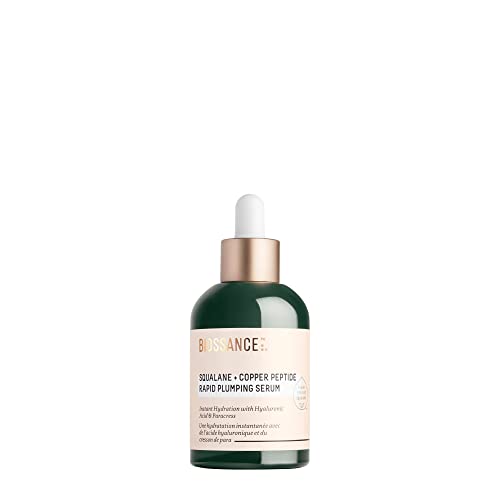
Biossance Squalane + Copper Peptide Serum Review: Quick Summary
- Product type: Topical facial serum
- Main purpose: Hydration, plumping, firmness, fine lines
- Best for: Dehydrated skin and early visible aging
- May not suit: Very sensitive or reactive skin
- Key ingredients or features: Copper tripeptide-1, squalane, hyaluronic acid, ectoin, paracress
- Return policy or guarantee: 30-day direct-purchase returns
- Overall rating: 4.0/5
Biossance currently states that direct purchases can be returned within 30 days of the ship date, excluding certain final-sale items. The current returns policy also explains the refund process and handling of damaged or incorrect orders.
What Is Biossance Squalane + Copper Peptide Serum?
This is a leave-on facial serum designed to hydrate, visibly plump, and improve the appearance of firmness, fine lines, and wrinkles.
Biossance recommends one full dropper applied to the cleansed face and neck, both morning and night. The product is marketed for all skin types while specifically targeting dehydrated skin.
Its standout feature is the combination of copper peptides with several moisturizing ingredients. The blue-green appearance comes from the naturally blue color of the copper-peptide ingredients rather than an added cosmetic dye.
What Does Biossance Squalane + Copper Peptide Serum Claim to Do?
The manufacturer’s main claims are:
- Instantly increase skin hydration
- Produce a visibly plumper appearance
- Improve firmness and elasticity
- Reduce the appearance of fine lines and wrinkles
- Provide lasting hydration
- Support collagen production
Biossance reports that 100% of participants showed an immediate hydration increase, 97% noticed improved firmness and elasticity after one week, and 100% demonstrated reduced fine lines and wrinkles after four weeks. The company’s study description says the research involved 31 women ages 30 to 65.
These claims are fairly specific, but the evidence base is still small. I find the hydration claim easier to accept than the broader collagen and wrinkle implications.
How Is Biossance Squalane + Copper Peptide Serum Supposed to Work?
Glycerin, sodium hyaluronate, and sodium polyglutamate are humectants, meaning they help attract and hold water in the outer layers of skin.
Squalane works primarily as an emollient, helping soften skin and support a comfortable moisture barrier. Copper tripeptide-1 is intended to influence signaling involved in tissue repair and extracellular-matrix processes.
That mechanism is biologically plausible, but plausibility isn’t proof. The stronger question is whether this particular formula contains enough active material and delivers it effectively. The current label doesn’t provide enough detail to answer that confidently.
Biossance Squalane + Copper Peptide Serum Ingredients at a Glance
The current official formula is published in full on the manufacturer’s website. Biossance advises checking the package because ingredient lists can change; the current ingredient listing is therefore the most useful reference.
Main ingredients:
- Copper Tripeptide-1: Copper-bound peptide associated with tissue-repair signaling research.
- Squalane: Emollient that softens skin and supports moisture retention.
- Sodium Hyaluronate: Hyaluronic-acid salt used for hydration.
- Acmella Oleracea Extract: Botanical ingredient marketed for firming and smoothing.
- Ectoin: Protective molecule used for hydration and environmental-stress support.
- Sodium Polyglutamate: Film-forming humectant used for moisture retention.
Complete ingredient list:
- Water/Aqua/Eau
- Glycerin
- Propanediol
- Squalane
- Sodium Hyaluronate
- Hydroxyethyl Acrylate/Sodium Acryloyldimethyl Taurate Copolymer
- Copper Tripeptide-1
- Acmella Oleracea Extract
- Ectoin
- Tetrapeptide-30
- Palmitoyl Hexapeptide-52
- Copper PCA
- Panthenol
- Sodium Polyglutamate
- Camellia Sinensis Leaf Extract
- Aloe Barbadensis Flower Extract
- Passiflora Incarnata Flower Extract
- Melia Azadirachta Leaf Extract
- Solanum Melongena (Eggplant) Fruit Extract
- Curcuma Longa (Turmeric) Root Extract
- Ocimum Basilicum (Basil) Flower/Leaf Extract
- Coccinia Indica Fruit Extract
- Melia Azadirachta Flower Extract
- Ocimum Sanctum Leaf Extract
- Corallina Officinalis Extract
- Polyacrylate Crosspolymer-6
- Acacia Senegal Gum
- Xanthan Gum
- Phenoxyethanol
- Ethylhexylglycerin
- Citric Acid
- Caprylyl Glycol
Biossance Squalane + Copper Peptide Serum Ingredients: Detailed Analysis
The hydration system is the most convincing part of the formula. The anti-aging ingredients are interesting, but that’s also where the scientific evidence becomes less certain.
Copper Tripeptide-1
Copper tripeptide-1, often called GHK-Cu, is a small peptide bound to copper. Laboratory research suggests it can influence extracellular-matrix activity and processes associated with tissue repair.
Human research exists, but it is limited. A small randomized study after carbon-dioxide laser resurfacing found no significant objective improvement in wrinkles or overall skin quality from GHK-Cu, although users reported higher satisfaction. The published clinical study therefore provides mixed rather than strong evidence.
More research is still underway. A 2026 Phase 2 trial is testing topical GHK-Cu in a wound-healing model, using a defined 0.1% formulation. The ClinicalTrials.gov record shows that results are not yet available.
The important limitation is concentration. Biossance does not disclose how much copper tripeptide-1 is present in this serum. I therefore can’t assume that evidence from a defined experimental concentration applies directly to this formula.
Squalane
Squalane is an emollient used to improve softness and reduce the uncomfortable feel of dryness. Biossance says its squalane is derived from sugarcane.
I am more confident about squalane’s moisturizing role than any dramatic anti-aging effect. In this formula, it makes practical sense as part of a broader hydration system rather than as a stand-alone wrinkle treatment.
Sodium Hyaluronate
Sodium hyaluronate is a form of hyaluronic acid that binds water. Topical hyaluronic-acid products have shown improvements in hydration, although results vary with molecular weight and formulation.
A randomized controlled trial of topical moisturizers containing different molecular weights of hyaluronic acid found improved skin hydration after four weeks. The clinical study on topical hyaluronic acid supports hydration as a reasonable expectation.
That evidence does not prove this serum will produce the same degree of benefit, because its concentration and molecular-weight profile aren’t publicly disclosed.
Acmella Oleracea Extract
Acmella oleracea, or paracress, is a botanical extract included for visible smoothing and firming. It has some human cosmetic research behind it, but the evidence is relatively limited.
I would describe the evidence as limited, not established. Research on a different Acmella-containing formulation can’t be treated as clinical proof for this serum.
Ectoin
Ectoin is a naturally occurring compatible solute that helps organisms protect cells under environmental stress. In skincare, it is mainly used as a protective and moisturizing ingredient.
The idea is reasonable, especially for supporting skin comfort, but I wouldn’t assign it a major role in wrinkle reduction. Its contribution here is better viewed as supportive than transformative.
Other Ingredients
- Glycerin: Humectant that attracts and retains water.
- Propanediol: Solvent and humectant used for formula texture.
- Hydroxyethyl Acrylate Copolymer: Stabilizer and texture modifier.
- Tetrapeptide-30: Peptide used for skin-conditioning purposes.
- Palmitoyl Hexapeptide-52: Peptide included for conditioning.
- Copper PCA: Copper-containing skin-conditioning ingredient.
- Panthenol: Humectant and skin-conditioning agent.
- Green Tea Extract: Botanical antioxidant and conditioner.
- Aloe Flower Extract: Skin-conditioning botanical.
- Passionflower Extract: Botanical skin conditioner.
- Neem Leaf Extract: Botanical antioxidant and conditioner.
- Eggplant Fruit Extract: Skin-conditioning botanical.
- Turmeric Root Extract: Botanical antioxidant.
- Basil Extract: Botanical skin conditioner.
- Coccinia Indica Fruit Extract: Botanical antioxidant source.
- Neem Flower Extract: Botanical skin conditioner.
- Holy Basil Extract: Botanical skin conditioner.
- Corallina Officinalis Extract: Marine botanical conditioner.
- Polyacrylate Crosspolymer-6: Thickener and stabilizer.
- Acacia Senegal Gum: Film former and texture modifier.
- Xanthan Gum: Thickener and stabilizer.
- Phenoxyethanol: Preservative used to protect the formula.
- Ethylhexylglycerin: Preservative booster and conditioner.
- Citric Acid: pH adjuster.
- Caprylyl Glycol: Humectant and preservative booster.
Phenoxyethanol is not automatically a safety concern. The European Commission’s scientific committee concluded that it is safe as a cosmetic preservative at concentrations up to 1%, based on its official safety assessment.
Does Biossance Squalane + Copper Peptide Serum Have Effective Ingredient Amounts?
This is the formula’s biggest transparency weakness. Biossance publishes the complete ingredient order, but it doesn’t disclose exact concentrations for the headline actives.
That makes it impossible to compare the copper peptide, hyaluronic acid, ectoin, or other highlighted ingredients directly with studied concentrations. I would not call them underdosed, but I also wouldn’t assume they are optimally dosed.
How Do You Use Biossance Squalane + Copper Peptide Serum?
The official instructions are straightforward: apply one full dropper to the cleansed face and neck, morning and evening. Biossance places treatment products before moisturizer and recommends SPF as the final daytime step. Official usage directions
The company says the serum can be used with retinol and advises a small patch test before use. It also suggests alternating certain treatment products rather than stacking multiple intensive products.
I would follow the label rather than trying to increase the amount for faster results. More serum isn’t necessarily more effective.
What Results Can You Realistically Expect?
The most realistic benefit is better hydration and temporarily fuller-looking, smoother skin. Humectants can make dehydration lines appear less pronounced by increasing surface water content.
The company’s 28-day study is encouraging, but 31 participants is a small sample. It also doesn’t tell us how the serum performs against a placebo over longer periods or against established anti-aging ingredients.
My expectation would be modest cosmetic improvement with consistent use, not dramatic reversal of wrinkles or major structural changes.
Ease of Use and Overall User Experience
The formula is designed as a simple two-times-daily serum, and the manufacturer describes its texture as silky enough for facial massage tools. That makes the application format fairly convenient.
Customer feedback at Sephora currently includes 736 ratings, with glow, plumping, and texture among the qualities most frequently highlighted. The current Sephora listing provides useful consumer-feedback context, although reviews aren’t scientific evidence.
I haven’t personally tested the texture or finish, so I wouldn’t present those qualities as firsthand observations.
Safety, Side Effects, and Precautions
The published ingredient list contains no added fragrance, which may appeal to fragrance-sensitive users. Still, this is a relatively complex formula containing numerous botanical extracts, preservatives, and peptides.
Patch testing is sensible, especially for reactive skin. Stop using it if significant or persistent irritation develops. Anyone with known cosmetic allergies or a dermatologist-managed skin condition should check the ingredient list carefully before introducing it.
Product Quality and Manufacturing Transparency
Biossance deserves credit for publishing the entire INCI list, clear directions, product sizes, and study descriptions. That makes the basic formulation relatively easy for consumers to evaluate.
Where I remain less impressed is active-dose transparency. The company doesn’t tell buyers the percentages of the main ingredients, and I could not verify an independently published clinical trial of this finished serum.
The current listing also directs consumers to check the package for the latest ingredient information, which is good practice for a product that may be reformulated.
Customer Reviews and Common Complaints
Sephora’s current review section shows a strong volume of ratings, with glow, plumping, and texture repeatedly highlighted as positive attributes. Those patterns suggest the product is generally well received for its cosmetic feel and immediate appearance benefits.
Other consumer discussions are more mixed, with some people describing softer, more hydrated skin and others feeling that the effect wasn’t distinctive enough to justify repurchasing. These are individual experiences, not proof that the serum works or fails.
I would give more weight to consistent patterns across many reviews than to isolated reports of irritation or breakouts.
Biossance Squalane + Copper Peptide Serum Pros and Cons
- Strong hydration-focused formula
- Includes copper peptide
- Full ingredient list disclosed
- No added fragrance listed
- Simple twice-daily directions
- Active concentrations aren’t disclosed
- Finished-product evidence remains limited
Who Should Consider Biossance Squalane + Copper Peptide Serum?
The formula is most suitable for readers looking for hydration plus a peptide-focused anti-aging approach.
- People with dehydrated facial skin
- Shoppers interested in copper peptides
- Users who prefer fragrance-free formulas
- People wanting one multifunctional serum
- Adults with realistic wrinkle expectations
Who Should Avoid Biossance Squalane + Copper Peptide Serum?
The product may not be the best fit for people who need a very simple formula or stronger proof.
- Anyone with a known ingredient allergy
- People highly reactive to botanical extracts
- Users unwilling to patch test
- Buyers requiring disclosed active percentages
- Anyone expecting dramatic wrinkle reversal
Is Biossance Squalane + Copper Peptide Serum Good Value for Money?
You’re paying for a layered formulation that combines several moisturizing agents with copper peptides, botanical extracts, and supporting peptides.
That can make sense if you value convenience and a multifunctional serum. The main value concern isn’t the ingredient count, though. It’s the lack of disclosed concentrations, which makes comparison with more transparent products harder.
The clinical study adds some confidence, but I’d place greater weight on the formula’s hydration function than on its stronger anti-aging claims.
Biossance Squalane + Copper Peptide Serum: My Verdict
I consider this a worth-considering serum, especially for someone whose main goal is hydrated, smoother-looking skin with a copper-peptide component. The formula is thoughtfully assembled, and the ingredient disclosure is better than what many proprietary skincare products provide.
The evidence becomes less convincing once the claims move from hydration toward collagen stimulation and wrinkle reduction. The finished-product studies are small, the follow-up is short, and the concentrations of the highlighted ingredients remain undisclosed.
From my perspective, the best reason to choose this serum is its combination of hydration, plumping, and a peptide-focused formula. I would be more enthusiastic if Biossance disclosed active concentrations and published independent clinical evidence on the finished product.
Disclaimer
This review is based on current product information, ingredient analysis, available scientific research, manufacturer disclosures, and consumer feedback discussed above. Results vary between people. This article is educational and does not replace personalized medical advice, diagnosis, or treatment.