
Skin can become rough, dull, uneven, or congested when dead cells accumulate at the surface. A well-formulated chemical exfoliant can help loosen that buildup while improving the appearance of texture and tone without relying on physical scrubbing.
Sunday Riley Good Genes Lactic Acid Treatment is a leave-on AHA treatment built around lactic acid, with licorice, squalane, prickly pear, aloe, and other botanical ingredients. Its broad claims make it especially interesting for shoppers seeking smoother, brighter-looking skin.
I find the formula worth examining closely because the underlying ingredient has real clinical support, but the finished product does not disclose its lactic-acid percentage. Its impressive company claims therefore need to be separated from what independent research can actually establish.
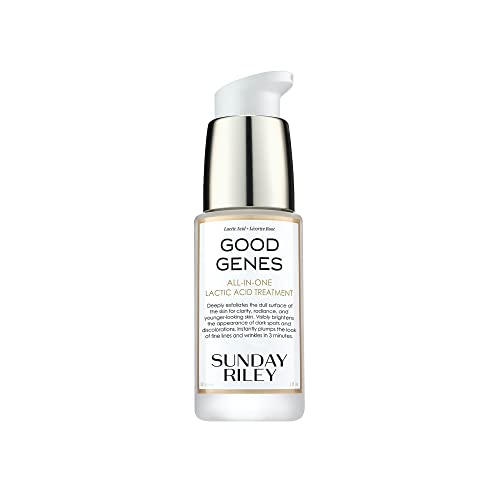
Sunday Riley Good Genes Lactic Acid Treatment Review: Quick Summary
- Product type: Leave-on AHA exfoliating treatment
- Main purpose: Texture, radiance, discoloration, fine-line appearance
- Best for: Dull, uneven, normal-to-dry or combination skin
- May not suit: Very reactive or fragrance-sensitive skin
- Key ingredients or features: Lactic acid, licorice, squalane, prickly pear, aloe
- Return policy or guarantee: 30-day satisfaction guarantee for direct purchases
- Overall rating: 4.1/5
What Is Sunday Riley Good Genes Lactic Acid Treatment?
Good Genes is a facial treatment centered on lactic acid, an alpha hydroxy acid that exfoliates the outermost layer of skin. The company markets it as a multifunctional treatment for dullness, uneven texture, discoloration, and visible fine lines, as described on its official product page.
The current formula is a creamy, leave-on product rather than a watery toner. The manufacturer recommends one to two pumps on clean, dry skin, either morning or evening, with a shorter rinse-off method suggested for sensitive skin, according to its usage guidance.
What distinguishes it is the combination of exfoliation with moisturizing ingredients and several botanical extracts. I see a sensible cosmetic concept here, although the formula contains many supporting ingredients whose individual contribution is difficult to isolate.
What Does Sunday Riley Good Genes Lactic Acid Treatment Claim to Do?
The company’s major claims include:
- Exfoliate dull surface skin
- Improve radiance and clarity
- Brighten dark spots and discoloration
- Smooth the appearance of lines and wrinkles
- Plump the appearance of fine lines within three minutes
- Support smoother, more even-looking texture
Most of these claims are specific enough to understand, but they aren’t equally supported. Exfoliation and improved texture have a reasonable scientific foundation for AHAs, while the three-minute clinical claim is much narrower and depends mainly on company testing.
I find the wording most convincing when it describes visible cosmetic improvements rather than implying that the treatment produces permanent changes. The evidence becomes less persuasive when broad ingredient benefits are treated as proof of the whole formula.
How Is Sunday Riley Good Genes Lactic Acid Treatment Supposed to Work?
Lactic acid works by weakening connections between cells in the outer skin layer, encouraging controlled shedding. The FDA explains that AHA exfoliation depends on factors including acid type, concentration, pH, and the rest of the formula in its AHA guidance.
The formula also includes squalane, emollients, humectants, and silicones that can make exfoliation feel less harsh. Licorice is included for brightening support, while botanical extracts are positioned as soothing or conditioning ingredients.
That mechanism is biologically plausible, but I would not confuse plausibility with proof. The strongest independent evidence applies to lactic acid and AHA use generally, not necessarily to this exact formula.
Sunday Riley Good Genes Lactic Acid Treatment Ingredients at a Glance
The current ingredient declaration lists the following components. For the reviewed formula, the complete ingredient listing is:
- Botanical blend: Aqua, Opuntia Tuna Fruit Extract, Cypripedium Pubescens Extract, Opuntia Vulgaris Leaf Extract, Agave Tequilana Leaf Extract, Arnica Montana Flower Extract, Aloe Barbadensis Leaf Extract, Saccharomyces Cerevisiae Extract, Leuconostoc/Radish Root Ferment Filtrate
- Core formula: Caprylic/Capric Triglyceride, Squalane, Lactic Acid, PPG-12/SMDI Copolymer, Propanediol, Butylene Glycol, Stearic Acid, Dimethicone, Cetearyl Alcohol, Phenyl Trimethicone, Disiloxane
- Texture and emulsifying system: Ceteareth-20, Glyceryl Stearate, PEG-100 Stearate, Stearyl Glycyrrhetinate, Glycyrrhiza Glabra Root Extract, Cymbopogon Schoenanthus Oil, Potassium Hydroxide
- Preservation and stability: Phenoxyethanol, Xanthan Gum, Caprylyl Glycol, Chlorphenesin, Sodium Phytate
Sunday Riley Good Genes Lactic Acid Treatment Ingredients: Detailed Analysis
The ingredients that matter most for the advertised benefits are the acid itself, the licorice components, and the moisturizing base. The botanical extracts are interesting additions, but their exact amounts and contribution are not disclosed.
Lactic Acid
Lactic acid is an AHA that exfoliates the skin surface. A randomized, double-blind study found that an 8% L-lactic-acid cream produced modest improvements in photodamaged skin compared with vehicle treatment after prolonged use, as reported in this clinical study.
That is meaningful evidence, although it used an 8% cream rather than this product. Good Genes does not disclose its lactic-acid percentage or pH, so I cannot say whether its concentration matches the studied formula.
I consider the ingredient evidence moderate, with the biggest limitation being dose and formulation differences. Lactic acid also has a known irritation and sun-sensitivity issue with topical AHA use, reflected in FDA safety guidance.
Licorice
Licorice-derived ingredients are included for brightening support. Human evidence exists for topical formulas containing licorice, including combination products studied for melasma, but that does not demonstrate that the small amount in this formula will reproduce those results. One relevant clinical study illustrates the limitation.
My confidence here is therefore limited to moderate. The ingredient is reasonable, but its precise concentration is unknown, and the research generally evaluates complete formulas rather than this specific combination.
Squalane
Squalane is an emollient that helps give skincare formulas a smoother, more comfortable feel while reducing the dry sensation that some exfoliating products produce. Its cosmetic safety has been reviewed by the Cosmetic Ingredient Review.
I see squalane as a useful supporting ingredient rather than a reason to buy the product by itself. Its presence makes the formula more cosmetically elegant, but it does not provide evidence that the treatment will outperform another lactic-acid product.
Other Ingredients
- Caprylic/Capric Triglyceride: Emollient that softens skin and improves slip.
- PPG-12/SMDI Copolymer: Skin-conditioning and formula-texture ingredient.
- Propanediol: Humectant and solvent that helps retain moisture.
- Butylene Glycol: Humectant and solvent supporting skin feel.
- Stearic Acid: Fatty acid used for conditioning and structure.
- Dimethicone: Silicone that smooths texture and reduces water loss.
- Cetearyl Alcohol: Fatty alcohol that thickens and conditions.
- Phenyl Trimethicone: Silicone that improves spreadability and finish.
- Disiloxane: Volatile silicone that improves slip and sensory feel.
- Ceteareth-20: Emulsifier that helps oil and water remain blended.
- Glyceryl Stearate: Emulsifier and skin-conditioning ingredient.
- PEG-100 Stearate: Plant-derived emulsifier supporting formula stability.
- Stearyl Glycyrrhetinate: Licorice-derived conditioning and soothing ingredient.
- Lemongrass Oil: Botanical ingredient providing conditioning and aromatic properties.
- Potassium Hydroxide: pH adjuster used to control formula acidity.
- Phenoxyethanol: Preservative used to control microbial growth.
- Xanthan Gum: Thickener that improves consistency.
- Caprylyl Glycol: Humectant and preservative-support ingredient.
- Chlorphenesin: Preservative assessed for cosmetic use by the CIR.
- Sodium Phytate: Chelating agent that helps stabilize the formula.
- Botanical extracts: Conditioning ingredients with limited product-specific clinical evidence.
Does Sunday Riley Good Genes Lactic Acid Treatment Have Effective Ingredient Amounts?
This is the formula’s biggest transparency weakness. Sunday Riley identifies lactic acid as a key active but does not disclose its percentage or finished-product pH on the current formula information.
The ingredient appears after the botanical blend, caprylic/capric triglyceride, and squalane. However, ingredient order cannot reliably establish a precise concentration, particularly when a proprietary botanical grouping is presented together.
Because the studied lactic-acid cream used a known 8% concentration, I would have more confidence in the evidence if Good Genes disclosed its percentage and pH.
How Do You Use Sunday Riley Good Genes Lactic Acid Treatment?
The official directions recommend one to two pumps on clean, dry skin as a leave-on treatment, morning or evening. It can be followed with moisturizer, while the company recommends a shorter rinse-off approach for sensitive skin in its official directions.
The FDA recommends following AHA instructions carefully and using sun protection because topical AHAs can increase sun sensitivity. Its AHA safety advice is relevant here.
I would avoid treating daily use as mandatory simply because the label permits it. Skin tolerance matters, especially when other exfoliating or irritating products are already part of a routine.
What Results Can You Realistically Expect?
The best-supported expectation is smoother-feeling skin with improved surface brightness and texture over time. Independent research supports modest improvements from topical lactic acid, particularly with consistent use over weeks rather than a single application, as shown in this lactic-acid trial.
The company’s three-minute plumping claim should be viewed more cautiously. Its published results come from company testing, including a small user assessment, rather than a large independent randomized trial, according to its reported clinical results.
Dark spots may improve visually, but established pigmentation disorders can require more targeted treatment and strict sun protection. I would not expect this product to erase deep discoloration or permanently change the skin.
Ease of Use and Overall User Experience
The formula is a creamy treatment rather than a thin acid toner, which should appeal to people who dislike watery exfoliants. The manufacturer also offers a sensitive-skin rinse-off method, adding flexibility to the routine.
Retailer feedback broadly supports its pleasant cosmetic feel. Sephora highlights hydration, radiance, and texture among highly rated qualities, while Ulta currently shows a 4.6 rating from more than 2,800 reviews across its consumer feedback.
I would not treat that feedback as proof of efficacy, because ratings reflect subjective experiences. Still, the volume and consistency of positive sensory comments make usability one of the product’s stronger consumer advantages.
Safety, Side Effects, and Precautions
The main established concern is AHA-related irritation and increased sun sensitivity. FDA guidance recommends sun protection during use and for a week afterward. Burning, redness, dryness, and peeling can occur, especially when exfoliation is excessive, according to its AHA guidance.
Lemongrass oil also deserves attention for highly sensitive users. DermNet lists lemongrass among essential oils known to cause allergic contact dermatitis in its essential-oil guidance.
People with very reactive skin, active irritation, or a history of fragrance-related allergy should be especially cautious. Younger users generally have less reason to use strong exfoliating anti-aging treatments and should consider age-appropriate skincare or professional guidance.
Product Quality and Manufacturing Transparency
The manufacturer provides a current full ingredient list, ingredient functions, usage directions, multiple package sizes, and information about sourcing for several ingredients. Those details are stronger than what many cosmetic brands provide.
The company says its brand is certified cruelty-free by PETA and Leaping Bunny on its brand FAQ. I could verify the company’s statement, although I did not independently confirm certificate records.
My main quality concern remains concentration transparency. Without the lactic-acid percentage and pH, consumers cannot easily compare its active strength with other AHA treatments.
Customer Reviews and Common Complaints
Sephora lists thousands of reviews and highlights hydration, radiance, and texture as common strengths. Ulta currently shows a 4.6 rating from more than 2,800 reviews, providing a large pool of practical feedback.
Independent consumer discussions also contain reports of strong warmth, burning, redness, unpleasant scent, or disappointment when expected pigmentation improvements did not appear. A Sephora community discussion illustrates these individual experiences, which should not be treated as population-level safety data.
The company also moderates reviews submitted on its own site, as described in its review policy. That makes independent retailer feedback more useful when assessing recurring consumer concerns.
Sunday Riley Good Genes Lactic Acid Treatment Pros and Cons
- Evidence-backed exfoliating ingredient
- Hydrating, cushiony supporting base
- Useful full ingredient disclosure
- Flexible leave-on or rinse-off use
- Strong retailer review volume
- Lactic-acid percentage isn’t disclosed
- Lemongrass may bother sensitive skin
Who Should Consider Sunday Riley Good Genes Lactic Acid Treatment?
The formula makes the most sense for people seeking controlled chemical exfoliation rather than aggressive peeling.
- People focused on uneven texture.
- Users wanting brighter-looking skin.
- Normal or combination skin may suit it.
- Experienced AHA users may appreciate flexibility.
- People preferring creamy treatments may enjoy it.
- Users comfortable with gradual cosmetic improvements may value it.
Who Should Avoid Sunday Riley Good Genes Lactic Acid Treatment?
A few groups should approach this formula more carefully.
- People with very reactive or damaged skin.
- Anyone with known lemongrass sensitivity.
- People who cannot reliably use sun protection.
- Those already overusing exfoliating acids.
- Younger users without a clear skincare need.
- Anyone expecting treatment-level correction of pigmentation.
Is Sunday Riley Good Genes Lactic Acid Treatment Good Value for Money?
From a consumer perspective, you’re paying for a sophisticated cosmetic base around a genuinely useful exfoliating ingredient. The moisturizing components, multiple supporting botanicals, creamy texture, and flexible application method add practical value.
The limitation is that comparable lactic-acid products can disclose their active percentage more clearly. Because Good Genes hides its concentration, I cannot conclude that its acid delivery is superior simply because the formula feels more luxurious.
The manufacturer’s 30-day satisfaction guarantee is a useful safeguard for direct purchases, although it has conditions and does not necessarily apply to purchases from retail partners. The relevant details are set out in the company’s return policy.
Sunday Riley Good Genes Lactic Acid Treatment: My Verdict
I consider Good Genes worth considering, particularly for someone who wants a polished, moisturizing AHA treatment focused on texture, radiance, and the appearance of fine lines. Its central ingredient has credible human evidence, and the overall formulation is more thoughtfully balanced than a bare acid solution.
My reservations are mostly about transparency rather than the basic science. The company does not disclose the lactic-acid concentration or pH, and its strongest three-minute claim relies on company testing rather than robust independent clinical evidence.
For me, that keeps it from being a clear evidence-based winner. The product appears well formulated and widely appreciated, but shoppers who prioritize measurable active concentrations may prefer a simpler AHA formula with more complete dosing information.
Disclaimer
This review is based on current product information, ingredient analysis, available scientific research, safety resources, and consumer feedback. Results vary between individuals. This article is educational and does not replace personalized medical advice, diagnosis, or treatment.